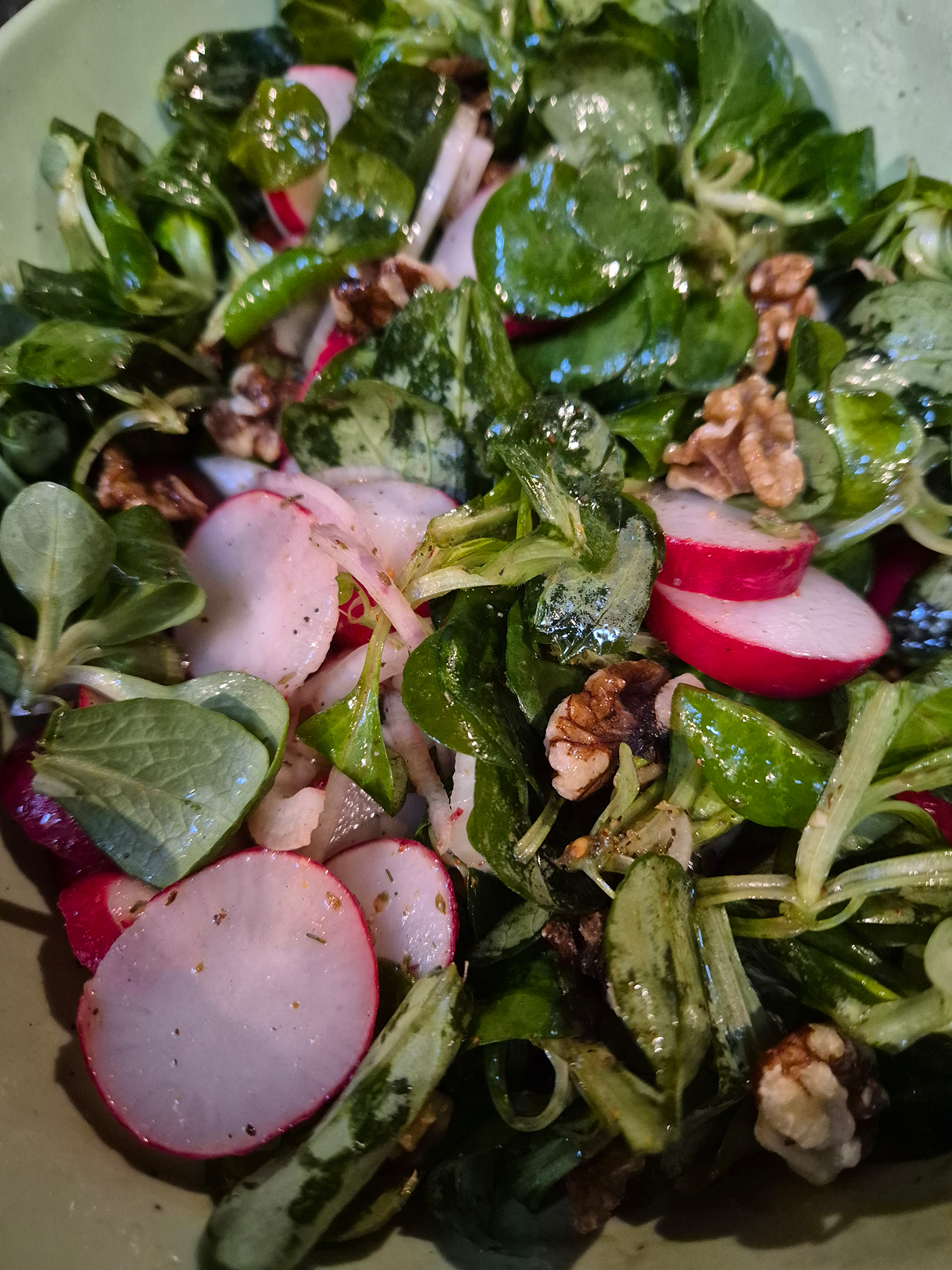
Orange carpaccio on leaf salad with chicory (vegan)


Ingredients for approx. 6 people:

½ head of lettuce
2 chicory heads
6 oranges
2 pomegranates
For the vinaigrette:
2 tablespoons olive oil
1 tablespoon nut oil
1 tablespoon pumpkin seed oil
4 tablespoons balsamic vinegar
1 clove of garlic
Herb salt
Freshly ground black pepper
Also:
Chilli flakes

Preparation:

  1. Clean, wash and spin-dry the lettuce and arrange on flat plates.
  2. Wash and clean the chicory and remove the leaves. Arrange on top of the lettuce.
  3. Peel the oranges completely, then cut them crosswise into thin slices and arrange them in a circle on top of the salad.
  4. Cut the two pomegranates in half, turn them inside out, scrape out the pomegranate seeds and scatter them over the oranges.
  5. Peel the garlic, remove the germ and chop finely.
  6. For the vinaigrette, mix the olive, nut and pumpkin seed oil with balsamic vinegar and finely chopped garlic. Season with herb salt and freshly ground black pepper. Spread over the carpaccio and sprinkle with chilli flakes.


My tip:

  •  Replacing the lettuce with rocket gives it a spicy flavour.


Product description:

The orange is the fruit of the evergreen orange tree and is the most widely cultivated citrus fruit in the world. It has many culinary uses: as freshly squeezed orange juice, in fruit salads, jams, cakes, desserts and much more. The fruits ripen for several months before they are harvested. The white layer, the mesocarp, between the flesh and the peel, contains valuable secondary plant substances. There are different varieties of oranges, e.g. the navel orange, which is seedless and easy to peel. Or the Valencia orange, which has a distinctive red flesh and a unique taste.

Print Friendly

Ginger and carrot soup with orange juice and zest (vegan)


Ingredients for approx. 6 people:

1 onion
500 g carrots
A piece of fresh ginger
2 untreated oranges (juice and peel)
Coconut oil
Chilli flakes
3/4 l vegetable stock
Just under ½ l coconut milk
Cardamom powder
Coriander powder
Herb salt
Freshly ground black pepper


Preparation:

1. Peel and dice the onion.
2. Clean the carrots, wash them with a vegetable brush and dice or slice them.
3. Wash the ginger and chop or grate finely.
4. Wash the oranges, grate the zest and squeeze the juice.
5. Heat the coconut oil in a saucepan, sauté the diced onion and carrot pieces with the grated ginger. Add the chilli flakes.
6. Deglaze with the vegetable stock and squeezed orange juice.
7. Add the grated orange zest and simmer covered for about 15 minutes.
8. Then purée the soup and add the coconut milk.
9. Season with cardamom and coriander powder.
10. Reheat briefly before serving and season to taste with herb salt and freshly ground black pepper.


My advices :

    • If you don’t have any fresh ginger to hand, use ginger powder.
  • The soup also tastes delicious if you replace the carrots with Hokkaido pumpkin.


Product description:

The orange is the fruit of the evergreen orange tree and is the most commonly grown citrus fruit worldwide. It has many culinary uses: as freshly squeezed orange juice, in fruit salads, jams, cakes, desserts and much more. The fruits ripen for several months before they are harvested. The white layer, the mesocarp, between the flesh and the peel, contains valuable secondary plant substances. There are different varieties of oranges, e.g. the navel orange, which is seedless and easy to peel. Or the Valencia orange, which has distinctive red flesh and a unique flavour.

Print Friendly

Liebelei’s glazed reishi tofu with oranges (vegan)


Ingredients:
2 packs of smoked tofu
For the marinade:
4 cloves of garlic
2 shallots
Approximately 3 tablespoons of olive oil
3 tablespoons of tamari sauce
2 tablespoons of maple syrup
2 tablespoons of whole cane sugar (Sucanat)
2 teaspoons medium-hot mustard
Smoked paprika powder
Freshly ground black pepper
For the glaze:
1-2 tablespoons cognac or whisky
Zest of ½ orange
Juice of 1 orange
1-2 tablespoons sucanat
Chilli peppers
2 tablespoons jam (any variety)
Ginger powder
Paprika powder
Freshly ground black pepper
Also:
1-2 cloves (optional)
1 orange
Baking paper

Preparation:

1. The day before, drain the smoked tofu and dry it thoroughly with a cloth, pressing firmly to remove any excess liquid. It is important that the smoked tofu is very dry.
2. For the marinade, peel the garlic, remove the germ and chop finely.
3. Peel the shallots and chop finely as well.
4. Mix both with the olive oil, tamari, maple syrup, whole cane sugar and medium-hot mustard. Season the marinade with black pepper and smoked paprika powder.
5. Place the two blocks of smoked tofu in flat containers, pour the marinade over them and cover. Leave to marinate for 2-3 days. Halfway through, turn the smoked tofu and cover again.
6. When the smoked tofu has marinated long enough, preheat the oven to 170 degrees C.
7. Line a small baking tin with baking paper.
8. Cover the bottom of the baking tin with the orange slices and place the smoked tofu on top. Use a sharp knife to score the top of the smoked tofu and press the whole cloves into the smoked tofu.
9. Bake the smoked tofu for about 60 minutes.
10. In the meantime, make the glaze by placing the cognac or whisky, orange zest and juice, whole cane sugar (Sucanat), chilli peppers, jam, ginger and paprika powder and freshly ground black pepper in a saucepan, stir well and simmer gently for about 25 minutes until the glaze is reduced by half, thick and shiny.
11. Remove the smoked tofu from the oven, pour the glaze over it and return to the oven for about 10 minutes until the glaze on the smoked tofu has thickened.
12. Remove from the oven and leave to rest for about 15 minutes.
13. Before serving, remove the cloves and orange slices.


My Tips:

      • This smoked tofu also tastes delicious cold if you have any leftovers.

      • The orange slices will turn dark during baking. This is normal. It’s all about the flavour; they will be removed after baking anyway.

      • The alcohol can also be replaced with any leftover marinade.


Product description:

Sucanat contains all of the molasses from sugar cane. I prefer Sucanat for various recipes because of its brown colour and intense, caramel-like, malty flavour. As it is less processed, it contains more minerals than refined sugar, but has a lower sweetness.

Print Friendly

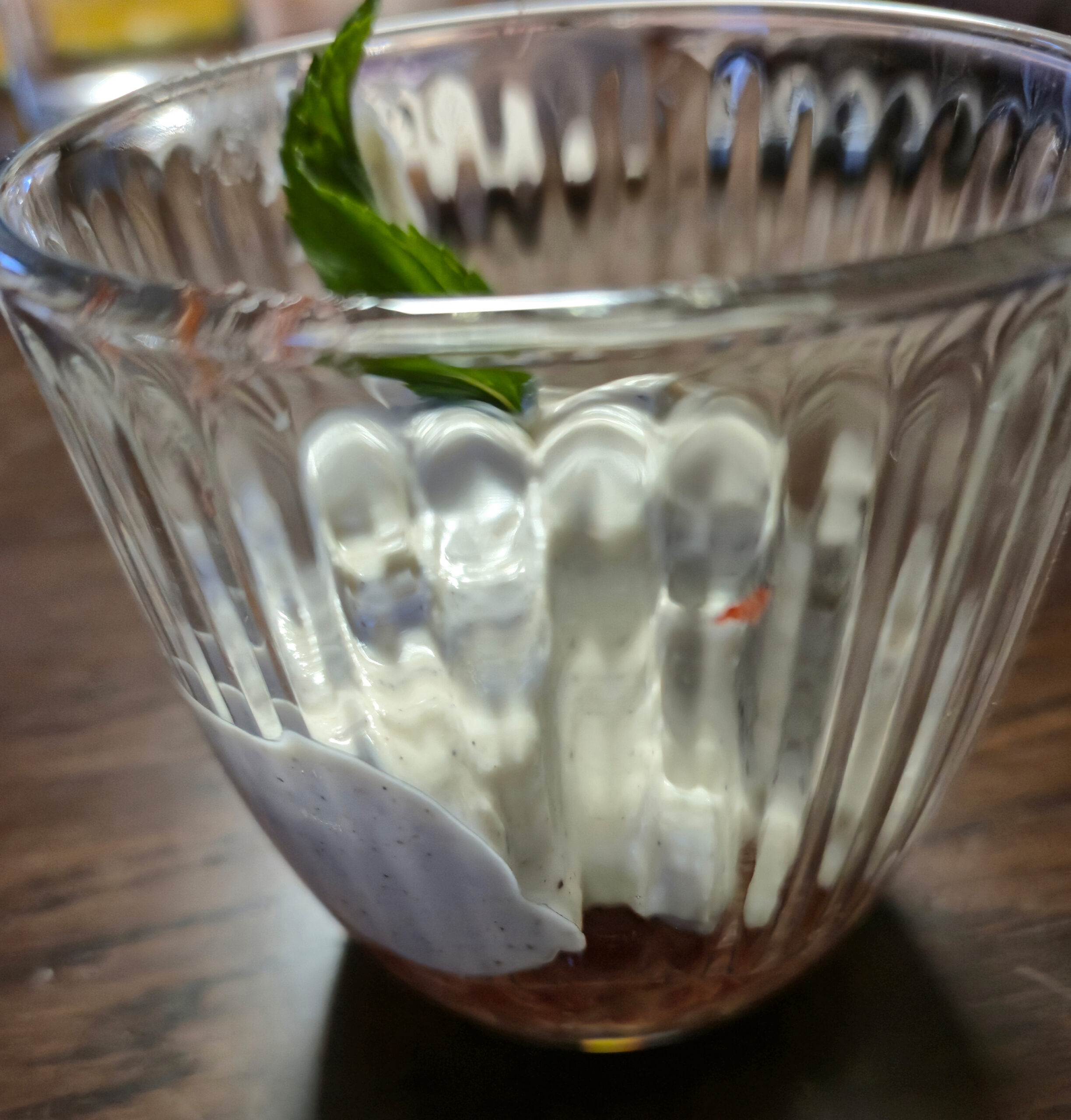
Quark and clementine dessert with speculoos biscuits (lacto-vegetarian)


Ingredients for approx. 6 glasses:

Approx. 200 g speculoos biscuits
Approx. 8 clementines
¼ l cream
1 packet vanilla sugar
500 g low-fat quark
150 g Greek yoghurt
80 g whole cane sugar
Ground vanilla
2-3 tablespoons orange liqueur
In addition:
a few clementines for decoration

Preparation:

1. Crumble the speculoos biscuits by placing them in a freezer bag and crushing them with a rolling pin.
2. Peel the clementines, remove the skin and set aside a few pieces for decoration. Finely chop the remaining clementine slices.
3. Whip the cream until semi-stiff, add the vanilla sugar and whip until stiff, then chill.
4. Mix the quark with the Greek yoghurt, whole cane sugar, ground vanilla and orange liqueur until smooth.
5. Carefully fold in the whipped cream.
6. Now fill the dessert glasses in layers with quark cream, crushed speculoos biscuits and chopped clementines. Finish with a layer of quark cream and garnish the desserts with the reserved clementine pieces and some speculoos crumbs (you can also top with a blueberry (only in summer) and chill until ready to serve).tellen.)


My tips:

    • The clementines can also be replaced with other seasonal fruits, e.g. oranges, mandarins, kiwis, bananas, cherries, pears, apples, etc.
  • For children, the orange liqueur can be replaced with a little orange juice.


Product description:

Clementines are a real autumn and winter classic and also incredibly healthy, as these citrus fruits are considered vitamin C boosters. They are a healthy alternative to oranges. Clementines are a cross between bitter oranges and mandarins. They are sweet and contain few seeds.

Print Friendly

Coconut biscuits (ovo-lacto-vegetarian)


Ingredients for approx. 20 biscuits:

50 g butter
80 g whole cane sugar
½ teaspoon ground vanilla
1 pinch of whole sea salt
2 eggs
50 g spelt flour (80 %)
2 teaspoons cream of tartar baking powder
200 g desiccated coconut
Also:
Baking paper

Preparation:

1. For the coconut biscuits, cream the butter, whole cane sugar, ground vanilla and pinch of whole sea salt in a mixing bowl.
2. Add the eggs and continue stirring.
3. Mix the spelt flour, cream of tartar baking powder and desiccated coconut into a smooth dough.
4. Shape the prepared dough into walnut-sized balls.
5. Line a baking tray with baking paper.
6. Place the dough balls on the tray, leaving space between them, and flatten them slightly with a spoon.
7. Bake the biscuits at 170 degrees C for about 10 minutes.
8. Remove from the oven and leave to cool on a wire rack.


My tips:

    • To intensify the coconut flavour, sprinkle toasted coconut flakes over the biscuits while they are still hot.
    • If you like, you can glaze the biscuits with a little melted chocolate.


Product description:

Desiccated coconut is versatile and can be used in sweet or savoury dishes. After the coconut harvest, the fruits are first dried for several days, then cracked open. The flesh is removed, cleaned and soaked before being finely grated. It is then dried to improve its shelf life.


Print Friendly

White beans with feta cheese and baked potatoes (lacto-vegetarian)

Ingredients for approx. 4 people:

300 g white beans
2 bay leaves
400 g potatoes
2 shallots
3 cloves of garlic
1 red chilli pepper
1 piece of feta cheese
Rapeseed oil
Garam masala
Cumin
1 jar tomato sauce
Herbes de Provence
Ghee
Herbal salt
Smoked paprika powder
For the garnish:
As desired: a few dried herbs
Dried tomatoes

Preparation:

1. For the bean dish, soak the white beans in water the day before. The next day, drain the beans and cook them in fresh water with 2 bay leaves until soft.
2. For the baked potatoes, scrub the potatoes with a vegetable brush, clean if necessary and cook in water until soft. Then drain and set aside.
3. Peel and finely dice the shallots.
4. Peel the garlic, remove the germ and chop finely.
5. Wash the chilli pepper, cut in half, remove the seeds and chop very finely.
6. Drain the feta cheese.
7. Heat the rapeseed oil in a deep pan, sauté the diced shallots, then add the chopped garlic and chilli pepper with the garam masala and cumin and fry briefly.
8. Add the drained white beans and tomato sauce, mix well and fill a baking dish with the mixture, placing the feta cheese in the middle. Sprinkle the cheese with spices and place the baking dish in the middle of the oven. Bake at 180 degrees C for about 20 minutes.
9. In the meantime, slice the potatoes and fry them in a frying pan with the ghee until crispy. Sprinkle with herb salt and paprika powder.
10. Before serving, serve the cooked bean dish with the fried potatoes. If desired, you can top the cheese with herbs and dried tomatoes.

My Tips:

  • You can replace the white beans with another type of legume, e.g. kidney beans, scarlet runner beans, adzuki beans, etc.
  • If you have any jacket potatoes left over from the day before, use these. This will make the fried potatoes even crispier.


Product description:

White beans are a source of protein that can be eaten at any time of year. They are available dried or in tins/jars. However, the dried variety contains more nutrients and is also more aromatic. Of course, the beans need to be soaked overnight before they can be used. White beans are very versatile and can be used in salads, soups, purées or as antipasti. They are rich in nutrients such as magnesium, potassium, calcium and phosphorus, and are above all an ideal source of protein.


Print Friendly

Cream tartlets with blueberry jam (ovo-lacto-vegetarian)


Ingredients for approx. 10 pieces:

For the dough:
400 g wholemeal spelt flour
1 pinch of sea salt
approx. 150 g whole cane sugar
200 g butter
2 eggs
1/8 l cold water
In addition:
Butter for greasing the moulds
Some flour for rolling out
For the topping:
1 vanilla pod
¼ litre milk
¼ litre cream
4 eggs
150 g whole cane sugar
Approximately 200 g blueberry jam
½ teaspoon ground cinnamon
2 tablespoons orange peel liqueur
Optional:
A little whole cane icing sugar for dusting, if desired.

Preparation: 
1. For the shortcrust pastry, knead the spelt flour with the sea salt, whole cane sugar, butter, eggs and water to form a dough. Wrap in cling film and place in the fridge for about 30 minutes.
2. Grease the tartlet tins with butter. Roll out the chilled dough thinly on a floured work surface and place in the tins, carefully pulling up the edges.
3. Preheat the oven to 180 degrees C. Prick the bases several times with a fork, cover with baking paper and weigh down with pulses. Blind bake for about 10 minutes, remove the baking paper and pulses, and bake the bases for another 5 minutes until golden brown. Remove from the oven and leave to cool.
4. Reduce the oven temperature to 160 degrees C.
5. In the meantime, slit the vanilla pod lengthways for the topping. Place the pulp in a saucepan with the milk and cream and heat until boiling.
6. Beat the eggs and whole cane sugar in a bowl until frothy.
7. Beat the milk mixture into the egg mixture and allow the mixture to cool slightly.
8. Pour the cream into the moulds and bake for another 20-25 minutes until set.
9. Mix the blueberry jam with a little cinnamon powder and 2 tablespoons of orange peel liqueur.
10. Remove the cooled tartlets from the moulds. Just before serving, spread 1-2 tablespoons of blueberry jam on top and dust with icing sugar.
11. The tartlets taste best when freshly prepared.


My tips:

    • You can obviously use a different type of jam, depending on your taste.
    • Leave out the orange liqueur if children are eating the cake and replace it with orange juice if necessary.


Product description:

The term marmalade comes from the Portuguese word ‘marmelo’ = quince, and is the traditional name for a spread. It is made from boiled fruit and sugar. This means that the term marmalade is actually only permitted for products made from citrus fruits and similar fruits, which may contain visible pieces of fruit, e.g. peel. Products made from other fruits are actually referred to as jam. However, the collective term marmalade is usually used for fruit spreads.


Print Friendly

Couscous pan with broccoli and egg topping (ovo-lacto-vegetarian)


Ingredients for approx. 4 people:

Approx. 200 g couscous
¼ litre hot water
400–500 g broccoli
½ tablespoon granulated vegetable stock
2 shallots
3 cloves of garlic
1 red chilli pepper
Rapeseed oil
Cumin
Coriander powder
Cardamom powder
Curry powder
For the egg mass:
4 eggs
60 g grated cheese
40 g Gorgonzola cheese
⅛ litre cream
Herb salt
Freshly ground black pepper
Smoked paprika powder
For the garnish:
A few sprigs of fresh parsley


Preparation:

1. For the couscous, bring the water to the boil and pour it over the couscous. Leave to swell.
2. Clean and wash the broccoli and remove the florets from the stalk. Cut the stalk into pieces or chop it up. Cook in a little water with granulated vegetable stock until al dente.
3. Peel and finely dice the shallots.
4. Peel the garlic, remove the germ and chop finely.
5. Wash the chilli pepper, cut in half, remove the seeds and chop very finely.
6. Drain the soaked couscous if necessary.
7. Heat the rapeseed oil in a deep pan, sauté the diced shallots, then add the chopped garlic and chilli pepper with the cumin, coriander, cardamom and curry powder and fry briefly.
8. Add the couscous, mix well, top with the drained broccoli and simmer covered for a few minutes.
9. In the meantime, crack the eggs, add the grated cheese and Gorgonzola cheese with the cream.
10. Season with herb salt, freshly ground black pepper and smoked paprika powder.
11. Pour the egg mixture over the broccoli and leave to set for a few minutes without a lid.
12. Wash and chop the parsley and sprinkle it over the couscous pan with the egg mass.


My tips:

  • The couscous pan also tastes great with other seasonal vegetables, e.g. courgettes, carrots, kohlrabi, Brussels sprouts, etc.
  • The couscous can also be replaced with pre-cooked millet, soaked amaranth or quinoa.


Product description:

Couscous is actually a type of semolina, usually made from durum wheat. It has a high starch and fibre content, which means it is not gluten-free. Couscous can be used in savoury dishes as well as sweet ones, making it very versatile.


Print Friendly

Pudding and plum tartlets with crumble topping (vegan)


Ingredients for approx. 6 tartlet tins:

For the shortcrust pastry:
200 g wholemeal spelt flour
1 pinch of sea salt
½ teaspoon cream of tartar baking powder
approx. 50 g whole cane sugar
100 g plant-based butter, e.g. Alsan
2-3 tablespoons cold plant-based milk
For the custard:
1 packet vegan vanilla custard powder
1 tablespoon whole cane sugar
1 packet vanilla sugar
approx. ¼ litre almond or oat milk
For the crumble topping:
150 g spelt flour (80%)
75 g whole cane sugar
1 packet vanilla sugar
100 g plant-based butter, e.g. Alsan
In addition:
Approximately 500 g plums
Ground cinnamon
A little butter for greasing the tart tins
Approximately 60 g ground nuts for sprinkling on the tart base
A little whole cane icing sugar for dusting the tart, if desired


Preparation:

1. For the shortcrust pastry, knead the wholemeal spelt flour with the whole sea salt, cream of tartar baking powder, whole cane sugar, plant-based butter and plant-based milk to form a smooth dough. Wrap in cling film and place in the fridge for about 30 minutes.
2. In the meantime, wash, stone and quarter the plums. Set aside.
3. For the custard, mix the vanilla custard powder with the whole cane sugar and vanilla sugar in about 4 tablespoons of plant-based milk. Then bring to the boil in the remaining plant-based milk, stirring continuously, to form a custard. Allow to cool slightly.
4. For the crumble topping, knead the spelt flour, whole cane sugar, vanilla sugar and plant-based butter together into crumbs of the desired size.
5. Grease the tartlet tins. Roll out the shortcrust pastry on a floured work surface, place it in the greased tartlet tins and pull up a rim.
6. Sprinkle the ground nuts over the pastry base, spoon the vanilla pudding into the cases, press in the quartered plums, dust with cinnamon powder and top with the prepared crumble.
7. Bake the tartlets on the middle shelf of the oven at 175 degrees C for about 45-50 minutes.
8. Remove from the oven, leave to cool in the tins and dust with a little whole cane icing sugar before serving.


My advice:

  • Instead of plums, you can of course top these tartlets with other seasonal fruits, e.g. damsons, cherries, mirabelle plums, greengages, etc.


Product description:

Plums belong to the same family as damsons, mirabelle plums and greengages. Plums are usually described as round, blue, red or yellow fruits with smooth, shiny skin. Regardless of which variety you choose, they are all bursting with vitamins, minerals and fibre.


Print Friendly

Winter leek and carrot millet risotto (lacto-vegetarian)


Ingredients for 4 people:

200 g millet
2 leeks
200 g carrots
3 shallots
4 cloves of garlic
Just under 1 litre of water
1-2 tablespoons of granulated vegetable stock
Rapeseed oil
⅛ litre white wine
Herb salt
Freshly ground black pepper
Cumin
Thyme
50 g grated Parmesan cheese
⅛ litre cream
In addition:
Smoked paprika powder

Preparation

1. Place the millet in a sieve and rinse with cold water. Leave to drain.
2. Clean and wash the leeks and cut into fine rings.
3. Clean the carrots, scrub with a vegetable brush and cut into small cubes.
4. Peel the shallots and cut into small cubes.
5. Peel the garlic, remove the germ and cut into fine slices.
6. Bring the water to the boil and add the granulated vegetable stock.
7. Heat the rapeseed oil in a saucepan and fry the chopped shallots with the leek rings and carrot pieces.
8. Add the drained millet and garlic slices, mix well and gradually deglaze with the prepared vegetable stock. Repeat this process until the vegetable stock is used up or the millet is soft.
9. Then add the white wine, bring to the boil briefly and season with herb salt, freshly ground black pepper, cumin and thyme.
10. Mix in the grated Parmesan cheese and finally the cream.
11. Season to taste, if necessary, and serve immediately in deep plates, dusted with smoked paprika powder.


My advices:

    • You can also use millet to make risotto.
  • Always use seasonal vegetables. This means you can make a summer millet risotto with aubergines, courgettes, tomatoes, etc.
  • If children are eating with you, replace the white wine with extra vegetable stock.


Product description:

Millet is rich in vital nutrients, gluten-free and easily digestible, it belongs to the sweet grass family. Whether sweet, sour or savoury, millet goes well with almost everything and can be combined wonderfully with vegetables or fruit.


Print Friendly