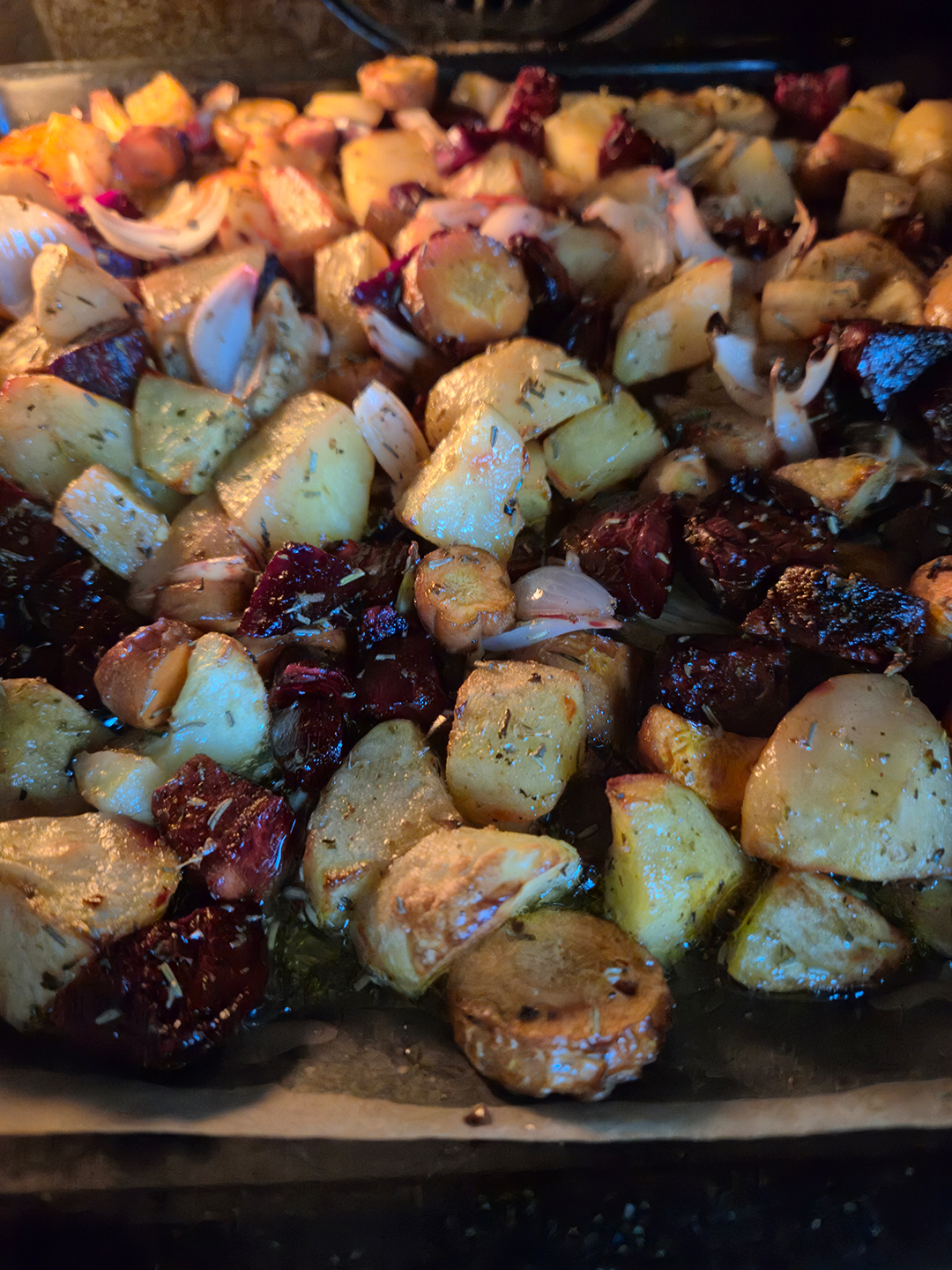
Hearty winter vegetables with herbs (vegan)


Ingredients for approx. 4 people:

Approx. 400 g waxy potatoes
3 beetroots
400 g carrots
300 g parsnips
300 g Jerusalem artichokes
1 small celery root
3 red onions
2 cloves of garlic
For the marinade:
4 tablespoons olive oil
2 tablespoons sesame oil
2 tablespoons mustard oil
Tamari
Herb salt
Freshly ground black pepper
Chilli flakes
Smoked paprika powder
Marjoram
Thyme
Rosemary needles
In addition:
Baking paper

Preparation:

1. For the winter vegetables, wash the potatoes with a vegetable brush and cut them into thick rectangles.
2. Wash and clean the beetroots and cut them into eighths.
3. Scrub the carrots with a vegetable brush, clean them and cut them into thick slices.
4. Peel, wash and clean the parsnips, if necessary, and also cut them into thick slices.
5. Wash the Jerusalem artichoke tubers, peel them if necessary and dice them.
6. Peel and clean the small celery root, cut into thick slices and dice.
7. Peel and roughly dice the red onions.
8. Peel and halve the garlic and remove the centre sprout.
9. For the marinade, season the olive oil, sesame oil and mustard oil with the tamari, herb salt, freshly ground black pepper, chilli flakes, smoked paprika powder, marjoram, thyme and rosemary needles.
10. Mix the prepared vegetables with the marinade.
11. Line a baking tray with baking paper and spread the marinated vegetables on it.
12. Cook the marinated vegetables in the middle of the oven at 180 degrees C for about 40 minutes. Turn from time to time.
13. When the vegetables are cooked, serve immediately.


My tips:

  • This recipe can be enjoyed as a main course or as a side dish.
  • If you like it a little spicier, use cayenne pepper instead of black pepper.


Product description:

Winter vegetables are a great way to get through the cold season. Always choose organic, regional and seasonal vegetables. Of course, there are other winter vegetables too, such as those from the cabbage family. This means you can always use whatever you have in your fridge or pantry.


Print Friendly

Cabbage rolls stuffed with lentils, served with herb-fried potatoes (vegan)


Ingredients for approx. 4 people:

For the fried potatoes:
500 g potatoes
Whole sea salt
Rapeseed oil
Herb salt
Freshly ground black pepper
Smoked paprika powder
Chopped rosemary needles
Thyme
Marjoram
For the white cabbage rolls:
1 white cabbage
Whole sea salt
For the lentil filling:
200 g beluga lentils
1 clove of garlic
2 shallots
Rapeseed oil
Herb salt
Freshly ground black pepper
Cumin
Marjoram
Curry powder
Paprika powder
A little tamari or shoyu
Sesame oil
A little turmeric gomasio
For the sauce:
3-4 tablespoons tamari or shoyu
2 teaspoons cornflour for the soy sauce
In addition:
A little vegetable margarine for greasing the baking dish
Sesame oil for brushing the cabbage rolls


Preparation:

1. For the herb-fried potatoes, scrub the potatoes with a vegetable brush, wash them, peel them if necessary, and boil them in a little whole sea salt water until soft. Then drain, dry and slice them.
2. In the meantime, clean and wash the white cabbage and remove or cut off about 8-10 leaves. Cut the remaining cabbage in half, remove the stalk and finely chop or slice the remaining cabbage.
3. Blanch the 8-10 cabbage leaves in boiling water for a few minutes, drain and rinse with cold water. Cut the stalks off the cabbage leaves and leave to drain on a cloth.
4. Grease a flat baking dish with a little vegetable margarine.
5. For the lentil filling, rinse the Beluga lentils with cold water and cook until soft for 20-30 minutes. Then drain.
6. Peel the garlic, remove the germ and chop finely.
7. Peel and finely dice the shallots.
8. Sauté the shallots and finely chopped garlic in rapeseed oil in a pan. Then add the chopped white cabbage and cooked lentils and fry gently for a few minutes. Season with herb salt, freshly ground black pepper, cumin, marjoram, curry powder, paprika and a little tamari.
9. Place this lentil filling in the prepared white cabbage leaves. To do this, place 1-2 tablespoons of filling in the centre of each white cabbage leaf, fold in the sides and roll up carefully. Place them seam-side down in the greased baking dish. Brush each cabbage roll with a little sesame oil, sprinkle with turmeric gomasio and bake in the middle of the oven at 180 degrees C for about 10 minutes.
10. Slice the potatoes and fry in rapeseed oil in a deep pan until crispy. A few minutes before serving, season with herb salt, freshly ground black pepper, smoked paprika powder and chopped rosemary needles, thyme and marjoram, and fry briefly.
11. For the sauce, mix 2 teaspoons of cornflour with cold water in a saucepan, add a little tamari or shoyu, bring to the boil briefly and season with freshly ground black pepper.
12. To serve, brush a flat plate with a little tamari or shoyu, top with 1 or 2 cabbage rolls and the herb-fried potatoes, and add a little sauce to the rolls.


My tips:

  • The white cabbage leaves can also be replaced with other cabbage leaves, e.g. savoy cabbage, red cabbage, pointed cabbage.
  • Another variety of lentils is also suitable for the lentil filling, e.g. mountain lentils or Puy lentils.
  • If you don’t have any turmeric gomasio to hand, gomasio without turmeric seeds is also suitable, of course.


Product description:

Gomasio is an important part of Japanese and Korean food culture. It consists of goma (= sesame) and shio (= salt), which in our culture usually means sesame salt. Gomasio is made from roasted sesame seeds (traditionally black sesame) and whole sea salt. Outside Japan, it is usually made with light sesame seeds. Due to its spicy flavour and health benefits, this seasoning is gaining more and more fans. Turmeric seeds are also ground into turmeric gomasio.

Print Friendly

Baked cauliflower slices with mozzarella cheese (lacto-vegetarian)


Ingredients for approx. 4 people:

1 large cauliflower
3-4 tablespoons olive oil
2 tablespoons sesame oil
2 cloves of garlic
Herb salt
Freshly ground black pepper
Smoked paprika powder
Cumin
Coriander powder
Cardamom powder
2-3 teaspoons tamari
Approximately 300 g mozzarella cheese
In addition:
Baking paper


Preparation

1. For the cauliflower slices, remove the leaves from the cauliflower, wash and cut into thick slices.
2. Line a baking tray with baking paper.
3. Peel the garlic, remove the germ and chop finely.
4. In a small bowl, mix the olive oil with the sesame oil and crushed garlic and season with herb salt, freshly ground black pepper, smoked paprika powder, cumin, coriander and cardamom powder, and tamari.
5. Generously coat the cauliflower slices with the prepared seasoning. Season again with herb salt and freshly ground black pepper.
6. Place the seasoned cauliflower slices on a baking tray and bake in the middle of the oven at 180 degrees  for about 20 minutes.
7. In the meantime, slice the mozzarella.
8. After 20 minutes of baking, top the cauliflower slices with the mozzarella slices and bake in the oven for another 5 minutes.
9. Serve immediately.


My tips:

  • It makes a delicious main course when served with a leaf salad.
  • The slices can also be prepared with other vegetables, such as celery, kohlrabi, pumpkin, etc.


Product description:

Cauliflower, Karfiol, is available in classic white as well as green, yellow-orange and purple. It is an all-rounder when it comes to health, as it provides fibre, protein, vitamins and minerals. Whether in a pot, bowl, oven or grill, cauliflower can be prepared fresh and healthily. This makes cauliflower a versatile, low-calorie vegetable with a mild aroma. The season begins in spring and lasts until October.

Print Friendly

Hearty jerusalem artichoke goulash with smoked tofu (vegan)


Ingredients for approx. 4 people:
300 g carrots
500 g Jerusalem artichokes – topinambur
2 onions
2 cloves of garlic
400 g smoked tofu
Rapeseed oil
Approx. 1/2 litre vegetable stock
⅛ litre soy cream
Herb salt
Freshly ground black pepper
Cumin
Also:
A little vegan sour cream, if desired.

Preparation:

1. For the topinambur goulash, wash the carrots with a vegetable brush, peel them and slice them.
2. Scrub the Jerusalem artichokes with a vegetable brush, clean and cut into cubes.
3. Peel and roughly chop the onions.
4. Peel the garlic, remove the germ and cut into thin slices.
5. Cut the smoked tofu into small cubes.
6. Fry the smoked tofu with the onion pieces and garlic slices in rapeseed oil in a saucepan.
7. Then add the topinamabur cubes and carrot slices, fry briefly and deglaze with the vegetable stock. Simmer for about 15 minutes.
8. Then add the soy cream and season with herb salt, freshly ground black pepper and a little cumin.
9. To serve, spoon the goulash into deep plates and add a dollop of vegan sour cream if desired.


My tips:

  • This recipe can also be prepared as a gratin. To do this, sprinkle with some grated vegan cheese and bake in the oven at 180 degrees C for about 15 minutes.
  • The ragout tastes even heartier if you add chopped celery.
  • Please note: consuming large quantities of Jerusalem artichoke can cause flatulence in some people. However, in all my years of teaching cookery classes, I have found that this is only the case for participants whose diet is low in fibre. So, always go for fibre!


Product description:

Topinambur (Jerusalem artichoke), a root vegetable with a distinctive nutty flavour, offers an alternative to potatoes. The Jerusalem artichoke tuber is related to the sunflower. Its appearance is somewhat reminiscent of a ginger root, while its flavour is similar to that of artichokes. This is why the plant is also known as Jerusalem artichoke, Indian tuber, horse potato or wild sunflower. The white flesh can be prepared in many different ways, e.g. as a salad, soup, casserole, purée, oven-baked vegetable or crisps, meaning that Jerusalem artichokes can be eaten raw or cooked. The tuber is large, low in calories and, unlike potatoes, Jerusalem artichokes contain inulin instead of starch. This is an important dietary fibre that prevents blood sugar levels from rising quickly. In addition, the tuber has a probiotic effect, which has a positive impact on metabolism and intestinal function.

Print Friendly

Garlic, lupin and leek stir-fry with paneer cheese (lacto-vegetarian)


Ingredients for approx. 4 people:

400–500 g lupins (jar)
2 large leeks
2 cloves of garlic
Rapeseed oil
200 g cream cheese
¼ l vegetable stock
200 g paneer cheese
Herb salt
Freshly ground black pepper
Cumin
Curry powder
Cardamom powder
Coriander powder

Preparation

1. Pour the lupins from the jar into a sieve, rinse with cold water and drain.
2. Clean the leeks, cut them in half lengthways and rinse thoroughly with water. Then cut into fine strips.
3. Peel the garlic, remove the germ and chop finely.
4. Heat the rapeseed oil in a pan and sauté the chopped garlic and leek strips for about 5 minutes.
5. Then add the drained lupins with the cream cheese and vegetable stock and simmer for a few minutes.
6. Cut the paneer cheese into cubes, fry in rapeseed oil and add to the leek and lupins.
7. Bring to the boil briefly and season with herb salt, freshly ground black pepper, cumin, curry powder, cardamom powder and coriander powder.


My tips:

  • The paneer cheese can also be replaced with halloumi cheese.
  • This leek dish can be prepared with chickpeas or lentils.


Product description:

Lupins used to be known mainly as animal feed. But today we enjoy lupins in various ways, as they are considered a reliable source of protein, ideal for vegans or vegetarians. The seeds are about the size of chickpeas and, in addition to protein, are also rich in fibre.

Paneer cheese is a typical cheese from Indian cuisine. It is a vegetarian protein pack with amino acids and a high calcium content. It can be baked, grilled and combined with many vegetables.

Print Friendly

Orange carpaccio on leaf salad with chicory (vegan)


Ingredients for approx. 6 people:

½ head of lettuce
2 chicory heads
6 oranges
2 pomegranates
For the vinaigrette:
2 tablespoons olive oil
1 tablespoon nut oil
1 tablespoon pumpkin seed oil
4 tablespoons balsamic vinegar
1 clove of garlic
Herb salt
Freshly ground black pepper
Also:
Chilli flakes

Preparation:

  1. Clean, wash and spin-dry the lettuce and arrange on flat plates.
  2. Wash and clean the chicory and remove the leaves. Arrange on top of the lettuce.
  3. Peel the oranges completely, then cut them crosswise into thin slices and arrange them in a circle on top of the salad.
  4. Cut the two pomegranates in half, turn them inside out, scrape out the pomegranate seeds and scatter them over the oranges.
  5. Peel the garlic, remove the germ and chop finely.
  6. For the vinaigrette, mix the olive, nut and pumpkin seed oil with balsamic vinegar and finely chopped garlic. Season with herb salt and freshly ground black pepper. Spread over the carpaccio and sprinkle with chilli flakes.


My tip:

  •  Replacing the lettuce with rocket gives it a spicy flavour.


Product description:

The orange is the fruit of the evergreen orange tree and is the most widely cultivated citrus fruit in the world. It has many culinary uses: as freshly squeezed orange juice, in fruit salads, jams, cakes, desserts and much more. The fruits ripen for several months before they are harvested. The white layer, the mesocarp, between the flesh and the peel, contains valuable secondary plant substances. There are different varieties of oranges, e.g. the navel orange, which is seedless and easy to peel. Or the Valencia orange, which has a distinctive red flesh and a unique taste.

Print Friendly

Ginger and carrot soup with orange juice and zest (vegan)


Ingredients for approx. 6 people:

1 onion
500 g carrots
A piece of fresh ginger
2 untreated oranges (juice and peel)
Coconut oil
Chilli flakes
3/4 l vegetable stock
Just under ½ l coconut milk
Cardamom powder
Coriander powder
Herb salt
Freshly ground black pepper


Preparation:

1. Peel and dice the onion.
2. Clean the carrots, wash them with a vegetable brush and dice or slice them.
3. Wash the ginger and chop or grate finely.
4. Wash the oranges, grate the zest and squeeze the juice.
5. Heat the coconut oil in a saucepan, sauté the diced onion and carrot pieces with the grated ginger. Add the chilli flakes.
6. Deglaze with the vegetable stock and squeezed orange juice.
7. Add the grated orange zest and simmer covered for about 15 minutes.
8. Then purée the soup and add the coconut milk.
9. Season with cardamom and coriander powder.
10. Reheat briefly before serving and season to taste with herb salt and freshly ground black pepper.


My advices :

    • If you don’t have any fresh ginger to hand, use ginger powder.
  • The soup also tastes delicious if you replace the carrots with Hokkaido pumpkin.


Product description:

The orange is the fruit of the evergreen orange tree and is the most commonly grown citrus fruit worldwide. It has many culinary uses: as freshly squeezed orange juice, in fruit salads, jams, cakes, desserts and much more. The fruits ripen for several months before they are harvested. The white layer, the mesocarp, between the flesh and the peel, contains valuable secondary plant substances. There are different varieties of oranges, e.g. the navel orange, which is seedless and easy to peel. Or the Valencia orange, which has distinctive red flesh and a unique flavour.

Print Friendly

Liebelei’s glazed reishi tofu with oranges (vegan)


Ingredients:
2 packs of smoked tofu
For the marinade:
4 cloves of garlic
2 shallots
Approximately 3 tablespoons of olive oil
3 tablespoons of tamari sauce
2 tablespoons of maple syrup
2 tablespoons of whole cane sugar (Sucanat)
2 teaspoons medium-hot mustard
Smoked paprika powder
Freshly ground black pepper
For the glaze:
1-2 tablespoons cognac or whisky
Zest of ½ orange
Juice of 1 orange
1-2 tablespoons sucanat
Chilli peppers
2 tablespoons jam (any variety)
Ginger powder
Paprika powder
Freshly ground black pepper
Also:
1-2 cloves (optional)
1 orange
Baking paper

Preparation:

1. The day before, drain the smoked tofu and dry it thoroughly with a cloth, pressing firmly to remove any excess liquid. It is important that the smoked tofu is very dry.
2. For the marinade, peel the garlic, remove the germ and chop finely.
3. Peel the shallots and chop finely as well.
4. Mix both with the olive oil, tamari, maple syrup, whole cane sugar and medium-hot mustard. Season the marinade with black pepper and smoked paprika powder.
5. Place the two blocks of smoked tofu in flat containers, pour the marinade over them and cover. Leave to marinate for 2-3 days. Halfway through, turn the smoked tofu and cover again.
6. When the smoked tofu has marinated long enough, preheat the oven to 170 degrees C.
7. Line a small baking tin with baking paper.
8. Cover the bottom of the baking tin with the orange slices and place the smoked tofu on top. Use a sharp knife to score the top of the smoked tofu and press the whole cloves into the smoked tofu.
9. Bake the smoked tofu for about 60 minutes.
10. In the meantime, make the glaze by placing the cognac or whisky, orange zest and juice, whole cane sugar (Sucanat), chilli peppers, jam, ginger and paprika powder and freshly ground black pepper in a saucepan, stir well and simmer gently for about 25 minutes until the glaze is reduced by half, thick and shiny.
11. Remove the smoked tofu from the oven, pour the glaze over it and return to the oven for about 10 minutes until the glaze on the smoked tofu has thickened.
12. Remove from the oven and leave to rest for about 15 minutes.
13. Before serving, remove the cloves and orange slices.


My Tips:

      • This smoked tofu also tastes delicious cold if you have any leftovers.

      • The orange slices will turn dark during baking. This is normal. It’s all about the flavour; they will be removed after baking anyway.

      • The alcohol can also be replaced with any leftover marinade.


Product description:

Sucanat contains all of the molasses from sugar cane. I prefer Sucanat for various recipes because of its brown colour and intense, caramel-like, malty flavour. As it is less processed, it contains more minerals than refined sugar, but has a lower sweetness.

Print Friendly

Quark and clementine dessert with speculoos biscuits (lacto-vegetarian)


Ingredients for approx. 6 glasses:

Approx. 200 g speculoos biscuits
Approx. 8 clementines
¼ l cream
1 packet vanilla sugar
500 g low-fat quark
150 g Greek yoghurt
80 g whole cane sugar
Ground vanilla
2-3 tablespoons orange liqueur
In addition:
a few clementines for decoration

Preparation:

1. Crumble the speculoos biscuits by placing them in a freezer bag and crushing them with a rolling pin.
2. Peel the clementines, remove the skin and set aside a few pieces for decoration. Finely chop the remaining clementine slices.
3. Whip the cream until semi-stiff, add the vanilla sugar and whip until stiff, then chill.
4. Mix the quark with the Greek yoghurt, whole cane sugar, ground vanilla and orange liqueur until smooth.
5. Carefully fold in the whipped cream.
6. Now fill the dessert glasses in layers with quark cream, crushed speculoos biscuits and chopped clementines. Finish with a layer of quark cream and garnish the desserts with the reserved clementine pieces and some speculoos crumbs (you can also top with a blueberry (only in summer) and chill until ready to serve).tellen.)


My tips:

    • The clementines can also be replaced with other seasonal fruits, e.g. oranges, mandarins, kiwis, bananas, cherries, pears, apples, etc.
  • For children, the orange liqueur can be replaced with a little orange juice.


Product description:

Clementines are a real autumn and winter classic and also incredibly healthy, as these citrus fruits are considered vitamin C boosters. They are a healthy alternative to oranges. Clementines are a cross between bitter oranges and mandarins. They are sweet and contain few seeds.

Print Friendly

Coconut biscuits (ovo-lacto-vegetarian)


Ingredients for approx. 20 biscuits:

50 g butter
80 g whole cane sugar
½ teaspoon ground vanilla
1 pinch of whole sea salt
2 eggs
50 g spelt flour (80 %)
2 teaspoons cream of tartar baking powder
200 g desiccated coconut
Also:
Baking paper

Preparation:

1. For the coconut biscuits, cream the butter, whole cane sugar, ground vanilla and pinch of whole sea salt in a mixing bowl.
2. Add the eggs and continue stirring.
3. Mix the spelt flour, cream of tartar baking powder and desiccated coconut into a smooth dough.
4. Shape the prepared dough into walnut-sized balls.
5. Line a baking tray with baking paper.
6. Place the dough balls on the tray, leaving space between them, and flatten them slightly with a spoon.
7. Bake the biscuits at 170 degrees C for about 10 minutes.
8. Remove from the oven and leave to cool on a wire rack.


My tips:

    • To intensify the coconut flavour, sprinkle toasted coconut flakes over the biscuits while they are still hot.
    • If you like, you can glaze the biscuits with a little melted chocolate.


Product description:

Desiccated coconut is versatile and can be used in sweet or savoury dishes. After the coconut harvest, the fruits are first dried for several days, then cracked open. The flesh is removed, cleaned and soaked before being finely grated. It is then dried to improve its shelf life.


Print Friendly